Replacement Doors or New Kitchen?
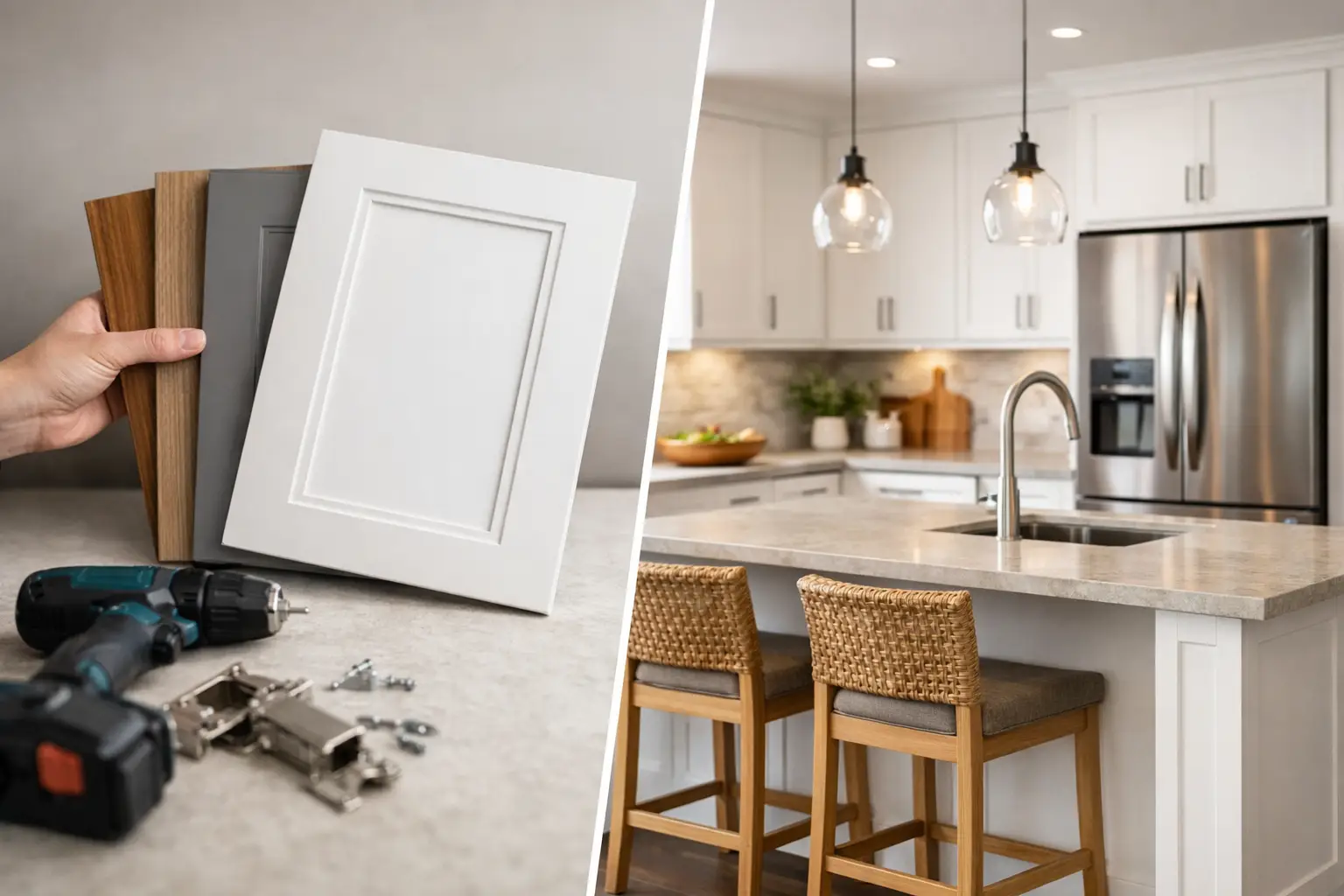
A full kitchen refit can feel like the obvious answer when the room starts looking tired. But if your cabinets are still solid, the layout works well and the storage does the job, the real question is often simpler: replacement doors or new kitchen?
For many homeowners, the answer comes down to what actually needs changing. If the cupboards themselves are sound, replacing the doors, drawer fronts, handles and worktops can transform the look of the room without the cost, mess and disruption of starting again. If the cabinets are failing, the layout is awkward or the space no longer works for day-to-day life, a full new kitchen may make more sense.
When replacement doors make the most sense
Replacement doors are often the right choice when the kitchen looks dated but still works properly. This is common in homes where the cabinet units were fitted well in the first place and have plenty of life left in them, yet the style now feels old-fashioned or worn.
In that situation, changing the visible parts can have a much bigger impact than people expect. New doors and drawer fronts sharpen the whole room immediately. Add updated handles, a fresh worktop, perhaps a new sink or tap, and the kitchen can feel far newer without changing the layout at all.
This approach is especially practical if you already know the room functions well. You know where everything goes, you are used to the way the space flows, and you do not want to turn a manageable update into a full renovation project. For busy households, that matters. Less upheaval is not a small benefit – it is often the deciding factor.
There is also more flexibility than many people assume. Replacement doors are not just a like-for-like swap in the same style. You can move from traditional to modern, from gloss to matt, from a pale finish to a darker shade, or the other way round. If standard sizes do not fit, made to measure options can help create a more tailored result.
When a new kitchen is the better investment
There are times when replacement doors are not enough. If cabinets are damaged, swollen or poorly fitted, it rarely makes sense to dress them up. New doors on failing units will not solve the underlying problem.
The same applies when the layout is wrong. If there is not enough worktop space, the oven is in an awkward position, the storage is frustrating, or the room simply does not suit the way you cook and live now, a full replacement may be the better long-term choice.
This is often the case in older kitchens designed for a different household routine. Perhaps you now need more pan drawers, integrated appliances, better use of corners or a layout that opens the room up for family life. In those cases, keeping the old framework can become a false economy.
A new kitchen can also make sense if multiple elements need changing at once and none of them are worth keeping. If the doors are tired, the cabinets are worn, the worktops are damaged and the overall design feels beyond updating, starting afresh may actually be more straightforward.
Replacement doors or new kitchen – what really affects the decision?
Cost is usually part of the conversation, but it should not be the only factor. Yes, replacement doors are generally more affordable than a complete new kitchen, especially when the existing cabinets are in good condition. But value matters more than headline price.
A cheaper option is only worthwhile if it gives you a kitchen you are happy to use for years. If replacing doors leaves you still unhappy with the layout, lighting or storage, you may end up doing the full job later. On the other hand, paying for a complete new kitchen when the units are perfectly serviceable can mean spending far more than necessary.
Condition is the first practical check. Open the cupboards. Look at hinges, shelves, carcasses and plinths. Are they sturdy? Do doors hang properly? Is there any swelling from moisture, especially under the sink? If the hidden structure is sound, a makeover becomes much more appealing.
Function comes next. Ask yourself whether the kitchen works, not just whether it looks good. Can two people use it comfortably? Is there enough storage where you need it? Do the appliances fit your routine? If the answer is mostly yes, then changing the appearance may be all that is needed.
Then there is disruption. A full kitchen replacement can mean days or weeks of upheaval, depending on the work involved. Replacement doors and related updates are usually far less intrusive. For many households, especially where the kitchen is the busiest room in the house, that practical difference carries real weight.
The middle ground that many homeowners overlook
It is not always a straight choice between replacing everything or doing the bare minimum. Quite often, the best result sits somewhere in between.
You might keep the existing cabinet units but replace the doors, drawer fronts and handles, then add a new worktop and sink. That can update both style and usability without moving plumbing or electrics. Or you may keep most of the layout but swap a few cabinets to improve storage in problem areas.
This middle-ground approach suits homeowners who want a kitchen to feel newer and work harder, but do not need a complete redesign. It is a sensible option when the basic structure is good yet a few details are letting the room down.
It also helps to see materials in person before deciding. Door samples, worktop finishes and handle styles can look very different in real life compared with a screen. What seems too dark online may look warm and practical in a showroom. A gloss finish you thought you wanted may turn out to show more marks than you would like in a family kitchen.
What a kitchen makeover can actually change
One reason people lean too quickly towards a full replacement is that they underestimate how much a makeover can do. It is not only about making the room look smarter.
New doors and drawer fronts can modernise the whole feel of the kitchen. New handles can make everyday use easier. A different worktop can brighten the room or give it more warmth. Replacing a sink and tap can improve practicality as much as appearance. Swapping outdated appliances for newer ones can also make the kitchen more efficient without altering the entire setup.
If your goal is to refresh the kitchen you already have, these changes are often enough to make the room feel considered again rather than simply old. The result can be cleaner, more useful and far more in keeping with the rest of your home.
Why local advice matters with replacement doors or a new kitchen
This kind of decision is easier when someone can look at the kitchen properly and talk through what is worth keeping. That is one reason a local showroom can be so useful. Rather than guessing from a brochure or ordering on the strength of a few photos, you can compare finishes, discuss sizes and get practical advice based on how your kitchen is built.
For homeowners around St Neots, Little Paxton, Huntingdon, Sandy or Bedford, that face-to-face support often helps cut through the uncertainty. Some kitchens are ideal for replacement doors. Others need more work. The point is not to push one answer every time, but to help you make the right call for your home.
At Replacement Kitchen Doors To Size, the conversation usually starts with what you want to improve. If you like the layout, want better style choices and need guidance on what can be updated without replacing everything, that is often where the best value is found.
The simplest way to decide
If your cabinets are solid and your kitchen still works well, replacement doors are usually the practical place to start. If the room is failing structurally or functionally, a new kitchen is likely to be the better investment. The tricky part is that many homes sit somewhere between those two positions.
That is why it helps to judge the kitchen on three things: condition, function and finish. If only the finish is the problem, a makeover is often enough. If condition and function are also poor, then a full replacement becomes easier to justify.
You do not always need a brand-new kitchen to feel better about the room you use every day. Sometimes the smartest move is to keep what still works, improve what does not, and take the time to choose finishes you are happy to live with.