Integrated or Freestanding Appliances?
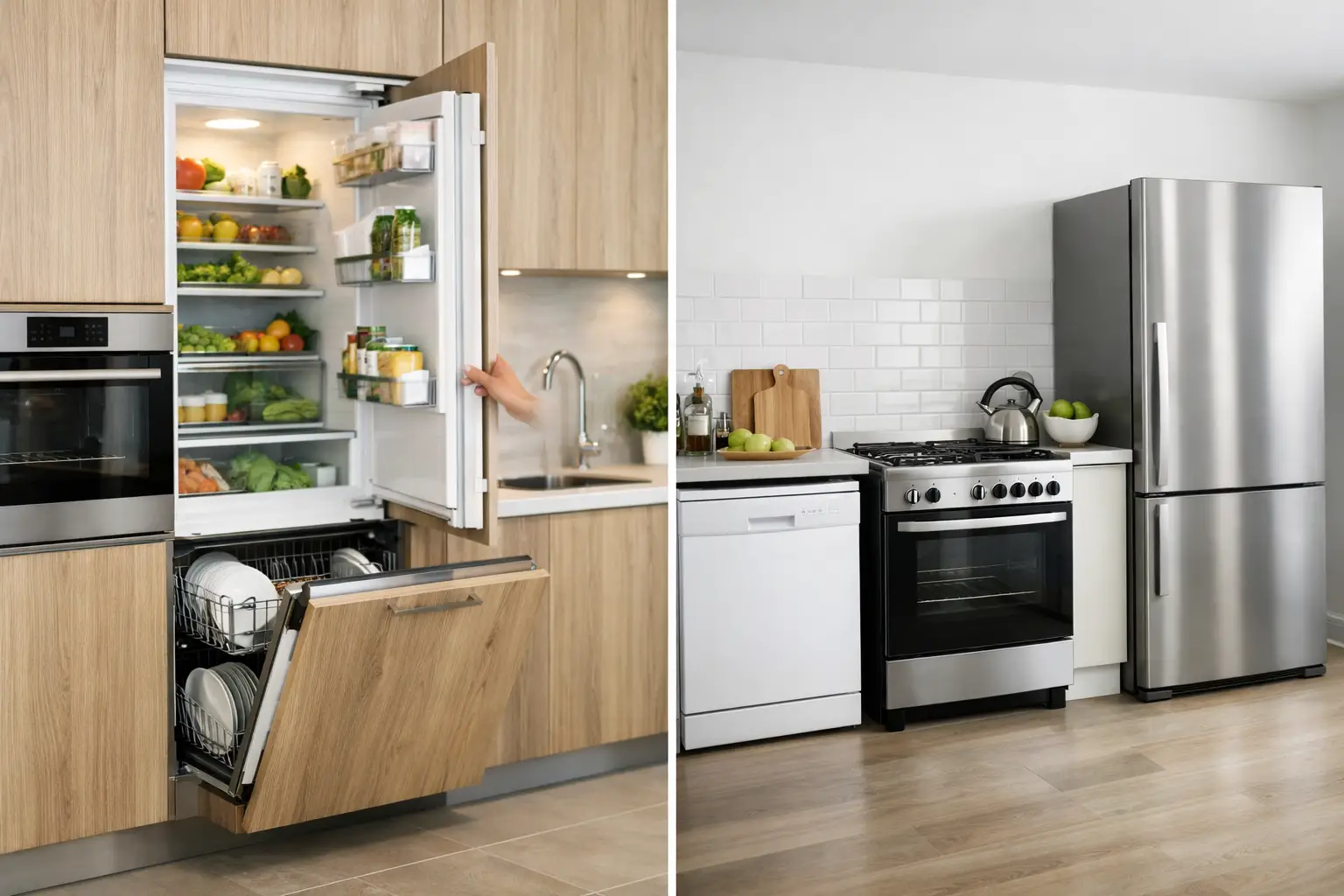
You usually notice this choice quite late in a kitchen project – right when the layout is taking shape and the practical questions start. Should you go for integrated or freestanding appliances? It sounds like a simple style decision, but it affects storage, cost, installation, maintenance and the way your kitchen works every day.
For some households, integrated appliances create the clean, fitted look they have always wanted. For others, freestanding models make more sense because they offer flexibility, simpler replacement and better value. The right answer depends less on trends and more on how you use your kitchen, how long you plan to stay in the property and what matters most in daily life.
Integrated or freestanding appliances – what is the difference?
Integrated appliances are designed to sit behind matching kitchen doors or fit neatly within cabinetry. The aim is to make the appliance blend into the overall design, so your dishwasher, fridge or washing machine does not interrupt the run of units. In many modern kitchens, especially handleless or open-plan designs, this can make the room feel calmer and more spacious.
Freestanding appliances are the opposite. They stand alone, with their own finished exterior visible. Think of a standard cooker, fridge freezer or washing machine that slides into place without needing a cabinet door fixed to the front. They tend to be easier to source, easier to replace and often available in a wider choice of sizes, finishes and price points.
Neither option is automatically better. It comes down to priorities.
When integrated appliances make the most sense
If you want a streamlined, cohesive kitchen, integrated appliances are often the stronger choice. They help the room feel less busy because the eye sees one continuous design rather than several separate machines. In smaller kitchens, that visual simplicity can make a noticeable difference.
They also work especially well in open-plan homes. If your kitchen shares space with a dining or living area, concealed appliances can help the room feel more like part of the home and less like a purely functional workspace. That matters if you spend a lot of time entertaining or want the kitchen to sit comfortably within a wider family area.
There can be practical benefits too. Tall integrated fridge freezers can be planned into a run of cabinetry to make better use of wall space, and integrated dishwashers are popular with households that want everything lined up neatly. In a bespoke kitchen, this level of coordination can help the whole design feel considered from the start rather than assembled in separate parts.
That said, integrated appliances do involve compromise. They are usually more expensive to buy and fit. Replacement can be more complicated because size compatibility matters, and if one appliance fails years down the line, you may need to find a model that works with the existing housing. Access for repairs can also be slightly less straightforward depending on the layout.
When freestanding appliances are the better option
Freestanding appliances appeal for good reason. They are practical, flexible and often better for tighter budgets. If you want to improve your kitchen without committing to a full redesign, they can be the more sensible route.
One of the biggest advantages is ease of replacement. If your fridge freezer stops working, you are not limited in quite the same way by cabinet dimensions and integrated door fittings. In many homes, that makes future maintenance less stressful and less costly.
Freestanding options can also give you more freedom in specification. You may find a wider range of capacities, features and finishes, especially if you are looking at range cookers, American-style fridge freezers or laundry appliances. For busy family kitchens, that extra choice can matter more than a perfectly uniform appearance.
There is also a design case for freestanding appliances. In the right kitchen, they do not have to look like an afterthought. A carefully chosen appliance in black, stainless steel or another complementary finish can add character and break up a run of cabinetry nicely. This is particularly true if you are not aiming for a fully minimal look.
Cost, value and the bigger picture
Budget often plays a major role in the integrated versus freestanding decision, and it is worth being realistic early on. Integrated appliances generally cost more because you are paying not only for the appliance itself but also for the cabinetry, housing and fitting involved. If your overall renovation budget is fixed, choosing integrated models across the board may mean making compromises elsewhere.
Sometimes that is absolutely worthwhile. If a fitted, high-end appearance is central to the design, the spend may feel justified every time you walk into the room. But there are also plenty of projects where a mixed approach gives better value.
For example, some homeowners choose an integrated dishwasher and fridge to keep the main view tidy, but go for a freestanding washing machine in a utility space or less visible part of the kitchen. Others prioritise a freestanding range cooker because they want cooking performance and presence, then integrate surrounding appliances for balance. This is often where good planning matters most – not following a rule, but choosing where your money works hardest.
Space planning matters more than people expect
Whether you choose integrated or freestanding appliances, layout should come first. Appliances need enough room to function properly, doors need clearance, and daily routines need to feel easy rather than cramped.
Integrated appliances require careful measuring because housing units, service gaps and ventilation all need to be allowed for. On paper, they can look neat and compact, but if the kitchen is not planned well, you may lose useful internal storage or end up with awkward spacing around corners and walkways.
Freestanding appliances can be more forgiving, but they still need proper thought. A large fridge freezer may dominate a smaller room. A freestanding cooker may require different clearances from nearby units or surfaces. The practical details matter just as much as the visual ones.
This is why appliance decisions work best when made as part of the kitchen design, not as an afterthought once the cabinets are chosen. In family homes around St Neots, Huntingdon and the surrounding area, we often find that the best kitchen is not the one with the most expensive specification, but the one arranged around the household’s actual habits.
Questions worth asking before you decide
It helps to step back and think beyond the showroom look. How long do you expect to stay in the property? Do you want a kitchen that feels highly tailored for the long term, or do you need flexibility over the next few years? Are you planning a full fitted kitchen or updating selected elements in stages?
You should also think about who uses the space. A busy family kitchen with heavy daily use may benefit from the easier replacement and wider capacity options often found in freestanding appliances. A couple renovating their forever home may prefer the cleaner appearance and built-in feel of integrated models.
Cleaning and upkeep are worth considering too. Integrated appliances can reduce visual clutter, but freestanding models may be easier to access and swap out if needed. If you are choosing based on practicality, these small day-to-day factors matter.
A balanced approach is often the best one
Many homeowners assume they must choose one route for every appliance, but that is not always necessary. In reality, some of the most successful kitchens combine integrated and freestanding appliances in a way that suits the room and the household.
A built-in dishwasher and fridge can preserve a polished look across the main cabinetry, while a statement cooker remains freestanding. A separate utility room might take the laundry appliances out of the kitchen altogether. A compact kitchen may benefit from integrating the appliances that are most visible, while leaving flexibility elsewhere.
That sort of decision-making tends to produce kitchens that still look smart years later because they are based on use, not just fashion. At The Kitchen Magician, that is usually where the best results come from – understanding how the space needs to work first, then selecting appliances to support it.
If you are weighing up integrated or freestanding appliances, the best starting point is not asking which option is supposedly better. It is asking what will make your kitchen easier to use, easier to live with and better suited to your home for the long term.