Before and After Fitted Kitchen Ideas
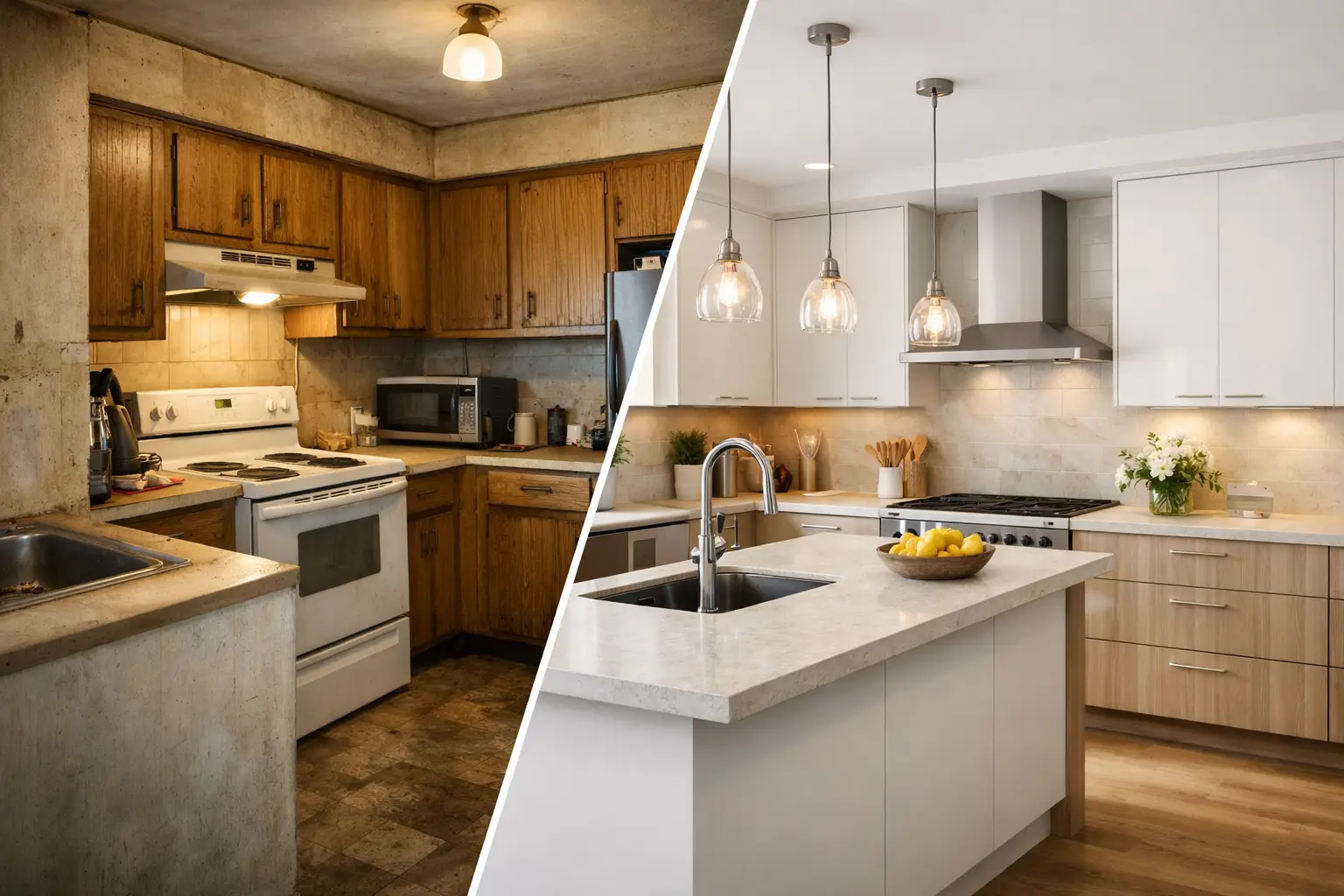
A before and after fitted kitchen transformation is often far less dramatic in process than it looks in the finished room. That is usually the surprise. Many homeowners assume a fresher kitchen means ripping everything out, living without cupboards for weeks and starting again from scratch. In reality, if your current layout still works, the biggest change can come from updating the parts you see and use every day.
That matters because most kitchens do not fail all at once. The cabinet units may still be sound, but the doors look tired, the drawer fronts are marked, the handles date the room, and the worktop has seen better days. You may even like where everything sits already. If the sink is in the right place, the appliances work within the room and the storage broadly makes sense, replacing the whole kitchen can be more disruption than improvement.
What a before and after fitted kitchen really changes
The best before and after fitted kitchen results are not only about appearance. Yes, the room looks brighter, cleaner and more up to date, but the real benefit is that it starts working better for everyday life. A kitchen can feel newer because the finish is more modern, but also because awkward details have been sorted properly.
That might mean swapping worn doors for a shaker style in a painted finish, replacing old laminate worktops with something more contemporary, or changing handles to give the whole room a cleaner line. It could also mean fitting a new sink and tap, adding plinths and end panels that match properly, or updating appliances so the kitchen performs as well as it looks.
This is where many homeowners find the value. You are not paying to move walls, chase pipes around the room or start over with a layout you already know works. You are improving the parts that make the kitchen feel dated, while keeping the structure that still does its job.
When keeping the existing layout makes sense
There is no rule that says a fitted kitchen only deserves attention if you are replacing every cabinet. In many homes around St Neots, Little Paxton and nearby villages, the existing kitchen footprint is perfectly serviceable. The issue is often not the plan of the room, but the finish and the details.
If your cabinets are sound and correctly fitted, a makeover can be a sensible route. It tends to suit homeowners who want a clear visual improvement without unnecessary upheaval. It also helps when the current kitchen already uses the space well. If your cooker, sink and work areas feel practical, changing all of that can add cost without adding much benefit.
Of course, it depends on condition. If units are damaged, poorly installed or no longer fit your needs, a full replacement may be the better answer. But many kitchens sit in the middle ground – structurally fine, visually tired. That is exactly where replacement doors, drawer fronts, worktops and finishing touches can make the biggest difference.
The details that make the biggest visual impact
Some changes transform a kitchen more than people expect. Doors and drawer fronts usually lead the way because they cover so much of the room. If those surfaces are faded, chipped or simply stuck in another decade, replacing them changes the look almost immediately.
Worktops come next. Even where cabinet doors are acceptable, a worn or dated worktop can drag the whole space down. A new worktop changes both the appearance and the feel of the room, especially when paired with a new sink and tap.
Handles, end panels, cornices, pelmets and plinths are the finishing pieces that pull everything together. These are the details that stop a kitchen looking partly updated. Homeowners sometimes focus only on doors, but the best before and after effect usually comes from treating the room as a whole. Not a total refit, but a complete refresh.
Colour and finish matter more than fashion
Trends have their place, but a kitchen works hard and needs to feel right in your home for years rather than months. Lighter shades can lift a dark room, especially where natural light is limited. Matt finishes often give a softer, more current look. Woodgrains can add warmth without making the room feel heavy.
That said, there is no single right answer. A small kitchen may benefit from pale tones, while a larger room can carry deeper colours comfortably. The important point is seeing samples properly and comparing them in person. What looks warm grey in one light can seem very different in another.
Practical upgrades often improve the “after” more than style alone
The strongest transformations usually include a few practical fixes as well as cosmetic ones. Soft-close hinges, better drawer action, a more useful sink, improved tap design and updated appliances all help the kitchen feel genuinely improved rather than simply redecorated.
That is often the difference between a room that photographs well and one that is easier to live with. A makeover should not only impress on day one. It should make weekday cooking, cleaning and storage feel simpler too.
Why showroom advice still matters
A kitchen update sounds straightforward until you are comparing edge profiles, finishes, handle spacing, made to measure sizes and worktop combinations. This is where online browsing tends to fall short. You can get ideas on a screen, but it is harder to judge quality, scale and colour accurately.
For local homeowners, visiting a showroom gives you a far clearer picture of what your own before and after fitted kitchen could look like. You can compare styles side by side, look at how finishes respond to light, and get practical guidance on what will work with your existing cabinets. That is especially useful if you are trying to match replacement parts to a current layout rather than starting from a blank sheet.
At Replacement Kitchen Doors To Size near St Neots, that kind of advice is central to the process. It is not about pushing a full new kitchen where one is not needed. It is about helping you refresh the kitchen you already have in a way that looks right and works properly.
Common expectations – and where reality differs
One of the most common assumptions is that a kitchen makeover is only worthwhile if the old room is truly awful. In practice, many of the most successful updates start with kitchens that are fairly decent but beginning to date. They are the kind of rooms that still function, yet no longer feel pleasant to spend time in.
Another assumption is that replacing doors alone always solves the problem. Sometimes it does. Sometimes it does not. If the worktop is badly worn, or the handles and trim clash with the new finish, the result can feel half-finished. Equally, there is no need to replace every single element if some parts are still in good order. The right approach sits between doing too little and doing too much.
Budget plays a part here as well. A phased update can make sense if you want to spread costs, but it works best when there is an overall plan. Choosing doors now and leaving incompatible worktops for later can create extra work. Better to look at the room as one scheme, even if the work happens in stages.
Planning your own before and after fitted kitchen update
Start with honesty about what actually bothers you. Is it the colour, the wear and tear, the storage, the worktop, or just a general feeling that the room is past its best? Once that is clear, the choices become easier.
Measure carefully, take photographs and think about what you want to keep. If the layout is good, that is a strength, not a compromise. Then focus on the combination of changes that will make the room feel complete. In many cases that means replacement doors and drawer fronts first, then worktops, handles and the details that finish the room properly.
It also helps to think about the kitchen at ordinary times, not just when it is spotless. Which surfaces need to be easy to clean? Which handles are comfortable to use every day? Do you want a finish that hides marks better in a busy family home? Practical questions usually lead to better long-term choices than chasing a look alone.
A good kitchen makeover is not about pretending the room is brand new. It is about making sensible improvements that give you the look, feel and function you wanted in the first place. When that is done well, the before and after difference speaks for itself – and the best part is that you still get to keep the layout that already works for your home.